Lead generation has become a focus for marketing teams, a key metric for proving their value.
In fact, 49% of marketers say lead gen is their top priority. Marketing is being judged on what it actually brings in—pipeline, revenue, customers—not awareness metrics that might pay off someday.
If you’re at an agency, the heat’s even higher. Clients want programs that prove return on investment.
This guide will help you think about lead generation as a whole system. You’ll see how it fits inside a broader marketing strategy and how to design scalable programs sustainably.
What Lead Generation Is (And What It Isn’t)
Lead generation is the process of identifying, attracting, and guiding potential customers into paid customers. It focuses on:
- attracting the right companies and personas,
- putting the right offers in front of them at the right moment, and
- collecting signals sales teams can act on.
Confusion usually starts when lead generation is blurred with neighboring disciplines.
Lead Generation Vs. Demand Generation
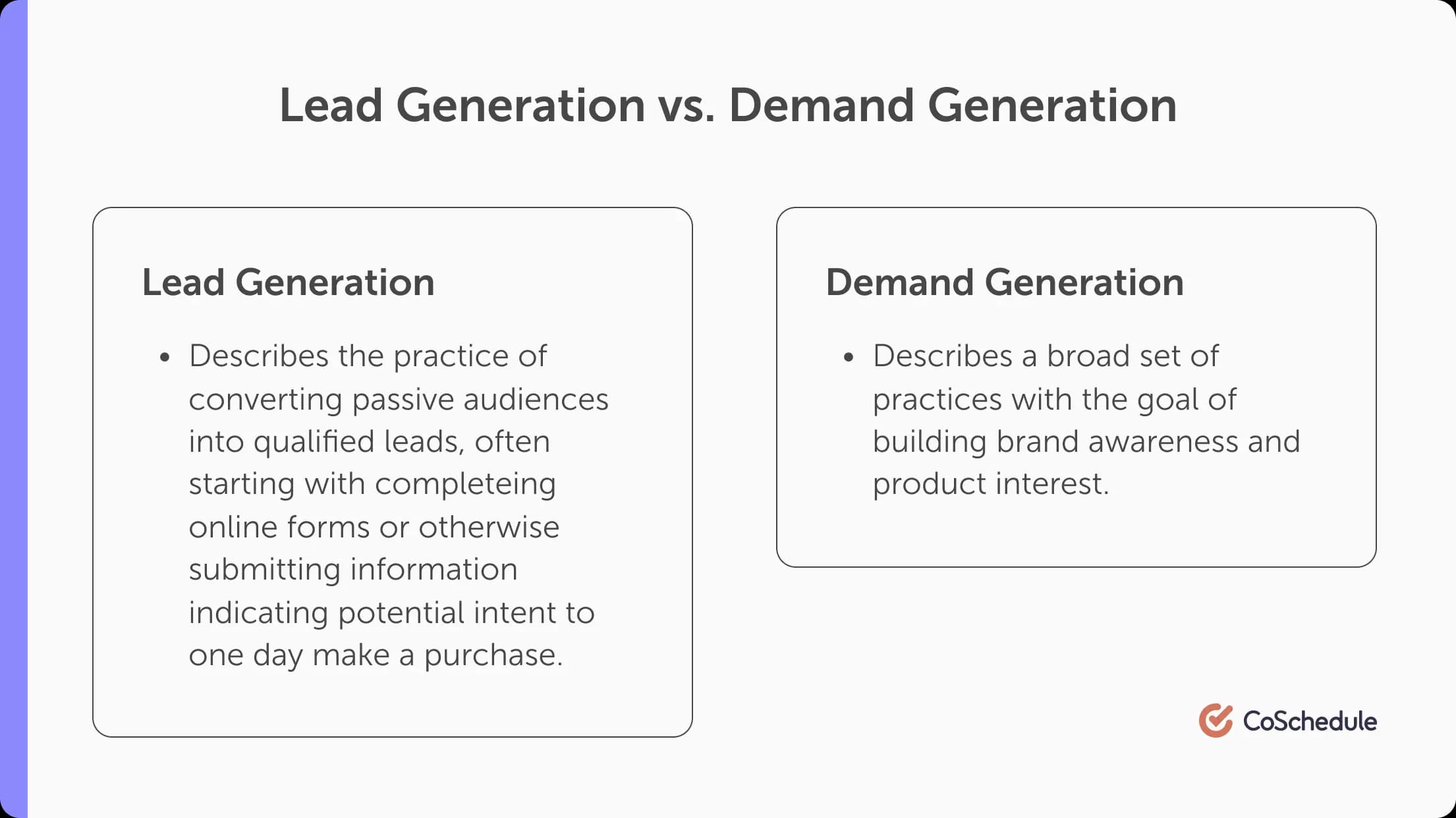
Demand generation comes first. It creates awareness before your target audience even realizes they’re actively looking for a solution.
This stage shapes how buyers think. It introduces the problem, builds trust, and keeps your brand visible through content, events, and industry conversations.
Lead generation happens downstream. It captures the interest that demand generation created and turns it into measurable action.
That’s when someone requests a demo, downloads a report, signs up for a webinar, or starts a trial—and becomes a known lead.
Lead Generation Vs. Growth Marketing
Growth marketing looks across the full customer lifecycle—from first touch through expansion. It considers what happens after someone becomes a lead. How quickly do deals move? What’s the conversion rate? Do customers expand? Do they stay?
Lead generation usually sits near the front of that path. Growth teams care about how those leads perform across the full path to revenue.
The Role Of Lead Generation In A Marketing Strategy Framework
Most marketing setups follow a simple order. People get familiar with you and start to trust you. That’s brand work. Then they learn about the problem they’re dealing with and why it’s worth fixing. That’s demand.
Lead generation comes after that, when someone is evaluating solutions and deciding what to do. It converts that interest into identifiable opportunities.
At that stage, a demo request, webinar registration, research download, or trial feels relevant because it matches intent. Lead generation captures that intent and turns it into a trackable opportunity sales can act on.
Once revenue targets are defined, lead generation becomes measurable.
Planning starts with pipeline goals, deal size, close rates, and sales cycle length. From there, you determine how many qualified opportunities you need and what type of leads can realistically produce them.
That shift changes how performance is judged. Volume matters less than conversion into pipeline and sales conversations, and campaigns are prioritized based on revenue impact.
Core Elements Of An Effective Lead Generation Strategy
Effective lead generation programs that scale well share these five elements:
Know Who You’re Reaching (Audience and ICP Clarity)
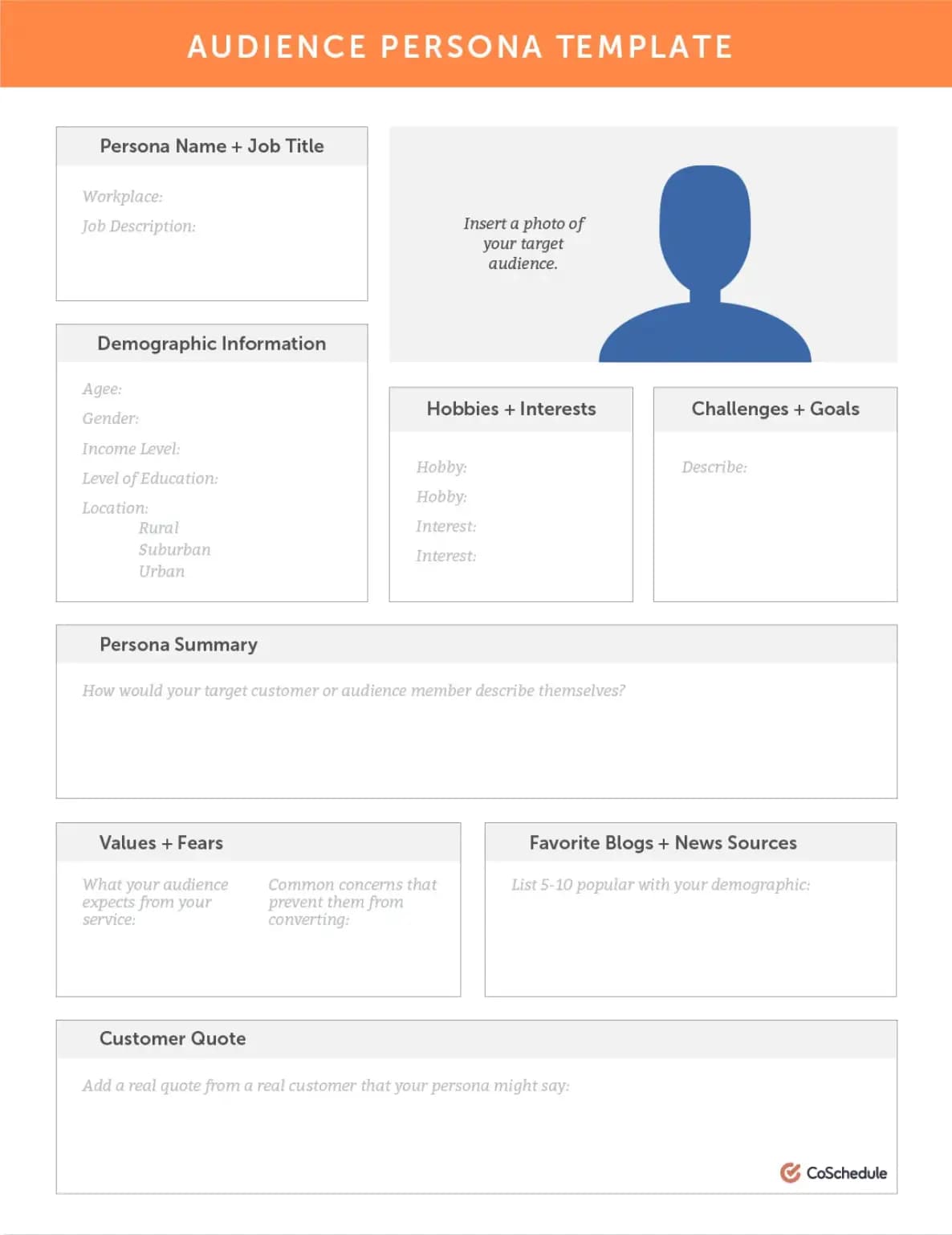
At the start, be ruthless about who your target audience and Ideal Customer Profile (ICP) is.
Get specific about which industries matter, what company sizes convert, which growth stages buy fastest, who sits on the buying committee, and what events push them into active research. If you run campaigns for multiple clients, add another filter—who can realistically drive near-term pipeline.
That clarity guides the rest of your work. It helps you choose the right keywords, the sites to pitch, the events to sponsor, and the accounts to target outbound.
Top Tip: If you need help zeroing in on your target audience, check out our inbound marketing campaign templates and examples.
Clarify Your Value (Value Proposition and Messaging)
Strong lead generation messaging speaks to problems buyers already feel. It frames outcomes in practical terms (e.g., cost reduction, efficiency gains) depending on what that role actually cares about.
Just as important, the story should stay consistent. Paid ads, landing pages, webinars, sales decks, and nurture emails should reinforce the same core story. If your positioning keeps changing, prospects struggle to connect the dots, and every campaign has to rebuild trust from zero.
Choose Your Channels (Channel Mix)
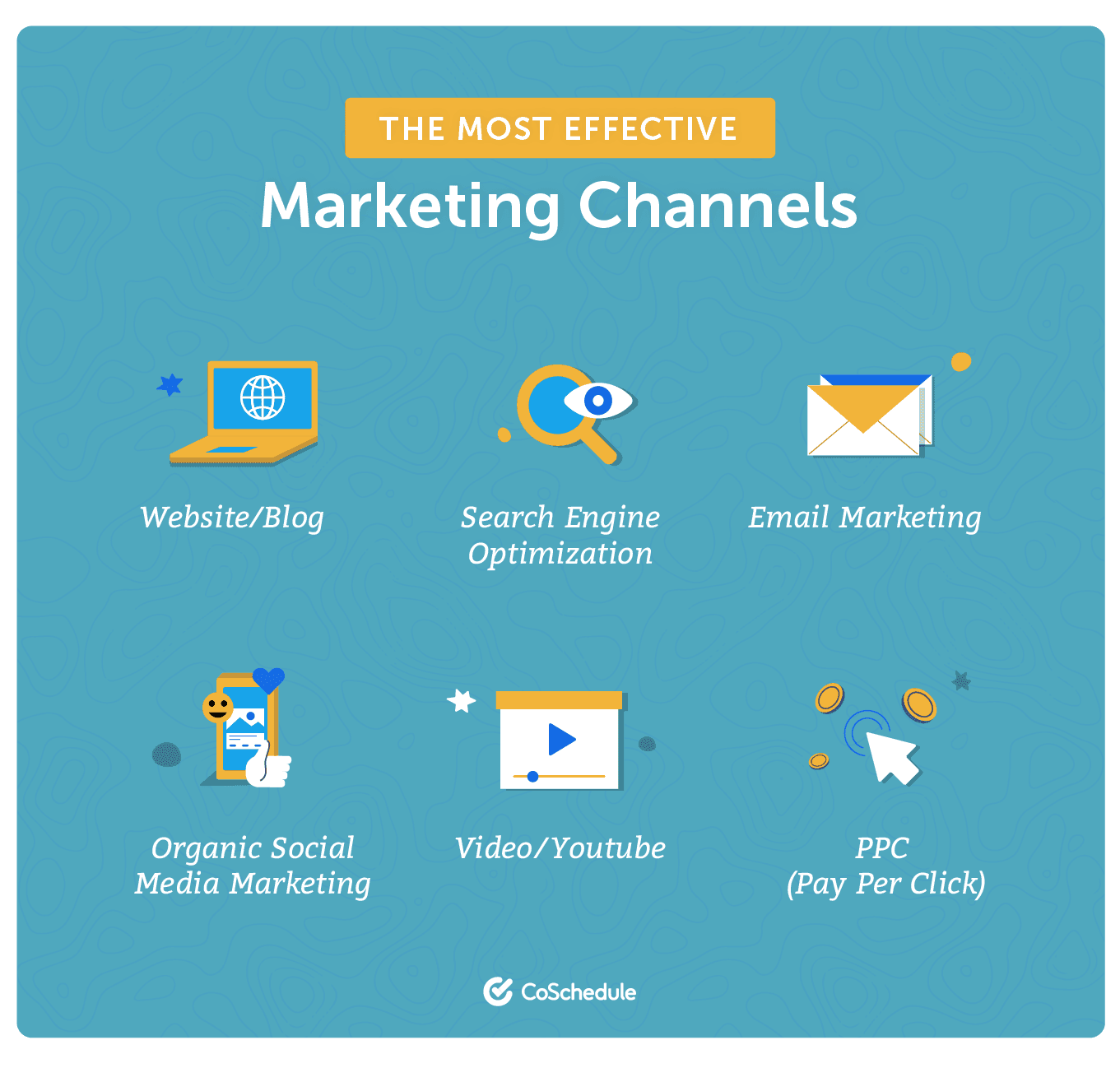
Marketing channels are how you execute the plan. Pick them based on how buyers move through deals:
- SEO and content capture people already researching.
- Paid ads help you break into priority segments faster.
- Email supports evaluation.
- Social distributes offers and keeps you visible to retargeted audiences.
The right mix will change with budget, market, and sales cycle length. What doesn’t change is the reasoning behind it. Invest in channels because they move buyers forward, not because they’re trendy or easy to launch.
Read More: How to Select Marketing Channels That Drive the Best Results
Create Clear Next Steps (Offers and Conversion Paths)
Offers turn prospects into leads—but only if they match where someone is in the buying process. For instance, demos fit teams close to choosing, and benchmarks help early researchers. Similarly, trials appeal to technical users testing whether the product holds up in real life.
You also have to look past the form fill. Routing rules, qualification steps, follow-up speed, and handoffs to sales decide whether a lead turns into a real conversation. Ignore that layer and your pipeline stays flat.
Measure And Improve (Measurement And Optimization)
Tracking how campaigns perform as deals progress is what makes a lead generation strategy predictable. You follow prospects into meetings, opportunities, and closed deals, then look for patterns across segments, offers, and channels. Those signals guide where to invest, what to pause, and which experiments deserve expansion.
Read More: The Ultimate Guide to Lead Generation for Agencies
Scaling Lead Generation With A Growth Marketing Strategy
Once your lead generation process works, the next question is whether you can grow it without sacrificing quality.
At this stage, growth marketing means optimizing for pipeline and revenue, not just MQL volume.
Rather than launching more campaigns, you improve what already exists and measure it against downstream impact.
That usually includes:
- Testing offers and formats to see which ones generate sales conversations, not just form fills
- Refining lead scoring so high-fit, high-intent prospects reach sales faster
- Tracking funnel movement from first touch to opportunity to closed revenue
- Measuring campaign-to-revenue attribution to see which programs influence real pipeline
This is where many teams get stuck. They celebrate MQL growth while the pipeline stays flat.
Thinking beyond MQLs changes the conversation. A smaller pool of qualified leads that converts is more valuable than a large list that stalls between marketing and sales.
Content also shifts at this stage. Instead of publishing one-off pieces, you build repeatable programs:
- Topic clusters that build authority
- Recurring webinars that generate consistent demand
- Research or flagship assets sales can reuse in later-stage conversations
Eventually, insights from lead behavior feed into onboarding and expansion. Acquisition and retention start informing each other. Lead generation becomes part of a broader revenue engine.
The Execution Gap
You can have a solid lead generation plan and still see things slip once the real work starts to pile up.
Most of the time, the plan isn’t the issue. It’s documented and agreed on. The problem is where execution happens, being spread across spreadsheets and conversations that never quite line up. After a while, nobody can see what’s live, what’s coming next, or which programs actually move revenue.
That disconnect is what slows lead generation as volume grows—and fixing that requires solid operational infrastructure.
Turning Plans Into Action With CoSchedule
When planning, publishing, and tracking live in different places, alignment fades fast.
CoSchedule pulls that work into one shared calendar so you can see campaigns, emails, social posts, and tasks in one view.
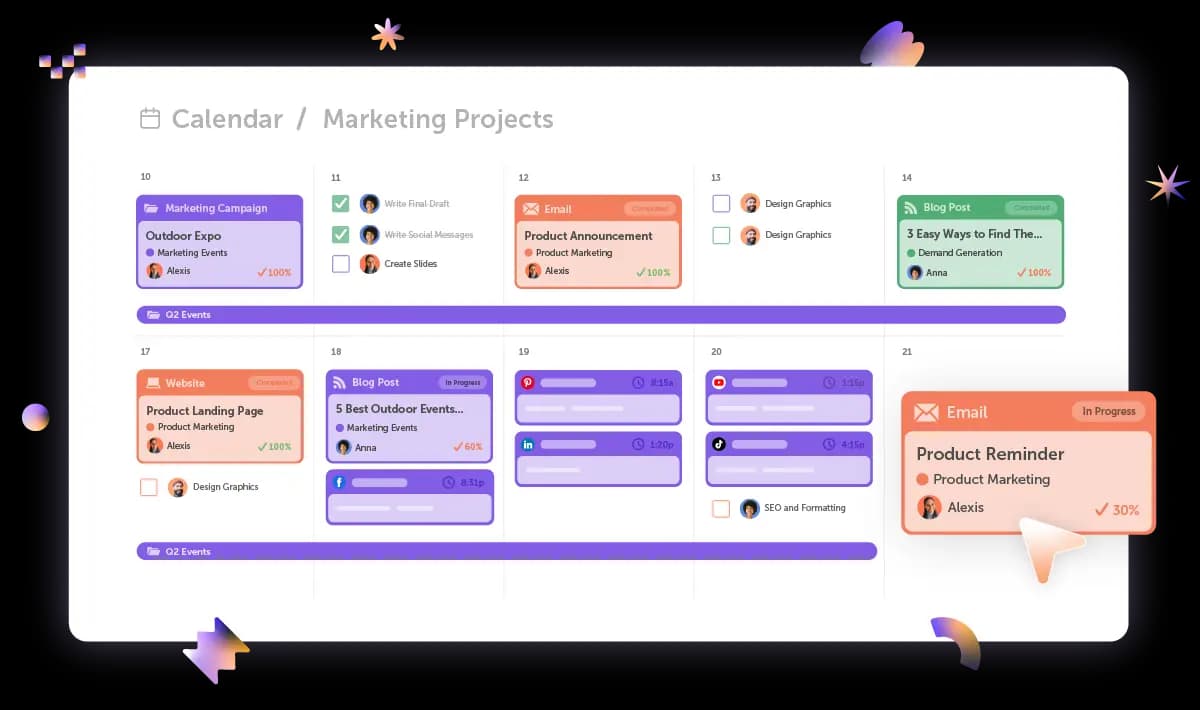
Here’s how you can use the platform:
Plan Integrated Lead Generation Campaigns
With CoSchedule, you can map an entire campaign in one view. Your main piece of content, the promotion around it, and the follow-ups all sit on the same timeline, which makes sequencing clearer and keeps the message consistent.
If you run the same kinds of launches often (think: webinars, reports, demo pushes), you can save them as templates. When you reuse one, the dates move, the tasks come back, and you don’t have to rebuild the whole program from scratch.
That way, you’re not just launching something—you’re preparing the audience and guiding them through the whole motion.
Keep Channels Aligned
Lead generation only works when content, email, social, and paid stay in sync. CoSchedule’s calendar helps you coordinate across those channels, so when something changes—like a webinar date or marketing copy—the related posts and emails update with it.
For agencies, that visibility makes it easier to manage multiple clients and keep priorities straight.
Learn And Adapt Faster
If your team wants to scale lead gen without drowning in disconnected docs and dashboards, CoSchedule gives you one place to plan and run campaigns with clarity. Explore the platform and see how it fits your workflow for free.
