Something has changed in marketing work, and it’s not “AI is here.” It’s how the work actually gets done.
Not long ago, a lot of time went into managing everything around the work. Teams had to decide where to start, how to adapt the same idea for another channel, and where a draft actually lived.
Now, more marketers are stating the task plainly: “Turn this blog into social posts.” “Make this client update clearer.” And getting something usable back immediately.
That shift matters when marketing involves constant production across channels. When progress slows, it’s rarely because ideas run out. It’s because effort keeps getting reset.
Conversational AI reduces that friction by staying inside the work. So, you can act on what’s already in front of you without resetting context.
In practice, that means AI embedded into planning and production—where drafts, decisions, and timelines already live. Tools like CoSchedule’s AI Marketing Assistant support this kind of in-place progress without adding another system to manage.
What Is Conversational AI?
Conversational AI
Conversational AI is technology that lets you interact with software using natural language, typed or spoken. You describe what you need, and the system responds in context.
For marketers, the important part is what this enables.
AI in marketing gives you the ability to work directly with incomplete ideas. You can ask for a rewrite, a summary, or a clearer version of something that already exists without setting up a task or switching tools.
The system stays with you as the work evolves. You can start with a rough idea, add context as it becomes clear (who it’s for, where it will live), and refine the output through back-and-forth—more like working through a draft with a teammate than operating a tool.
That’s why conversational AI fits real marketing work. It adapts to how thinking develops instead of forcing progress through rigid steps.
What Are The Different Types Of Conversational AI?
Conversational AI isn’t a single category. Different systems are built for different kinds of interaction, and those differences matter once you try to use them in real marketing workflows.
Below are the most common types you’ll run into, and what they’re actually good for.
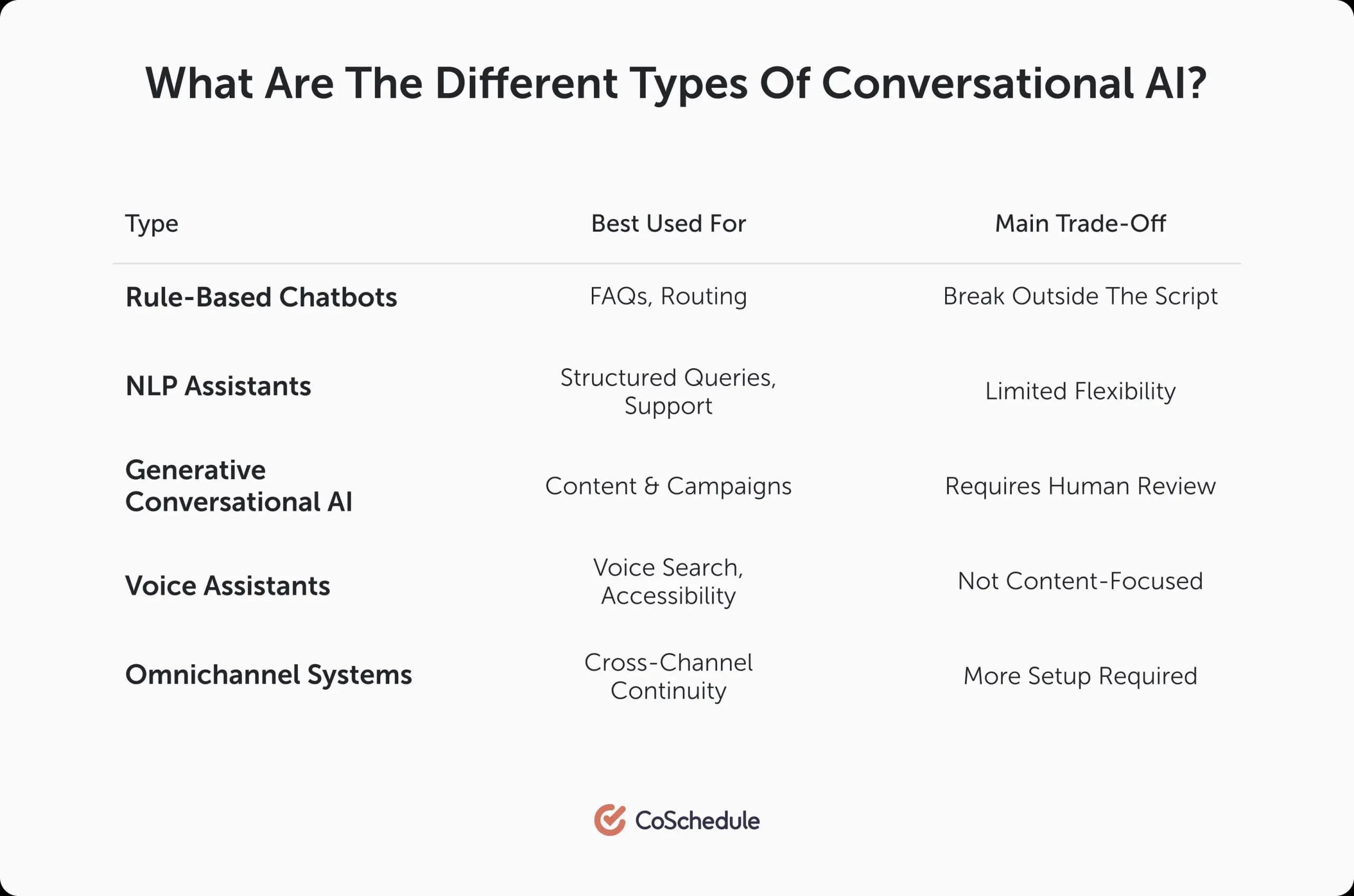
Rule-Based Chatbots
Rule-based chatbots follow scripts. A visitor clicks an option or asks a very specific question, and the system returns a predefined response.
They’re common on websites because they’re easy to control and predictable—as long as the conversation stays inside the script. Once a question falls outside what’s been anticipated, the interaction usually stops.
These AI marketing tools work well for basic, repeatable interactions, like answering common questions or routing visitors to the right place. They don’t hold up when the task requires interpretation, judgment, or anything resembling content work.
NLP-Based Assistants
Natural language processing (NLP) systems are more flexible. They can understand intent even when the wording isn’t precise.
They’re useful when the goal is to retrieve or summarize known information. Ask a structured question, and you’ll usually get a helpful response. Push into open-ended territory, and their limits become clear.
You’ll often see these used in internal documentation or guided analytics queries like “show traffic by channel last month.” They help you navigate information, but won’t collaborate on it.
Generative Conversational AI
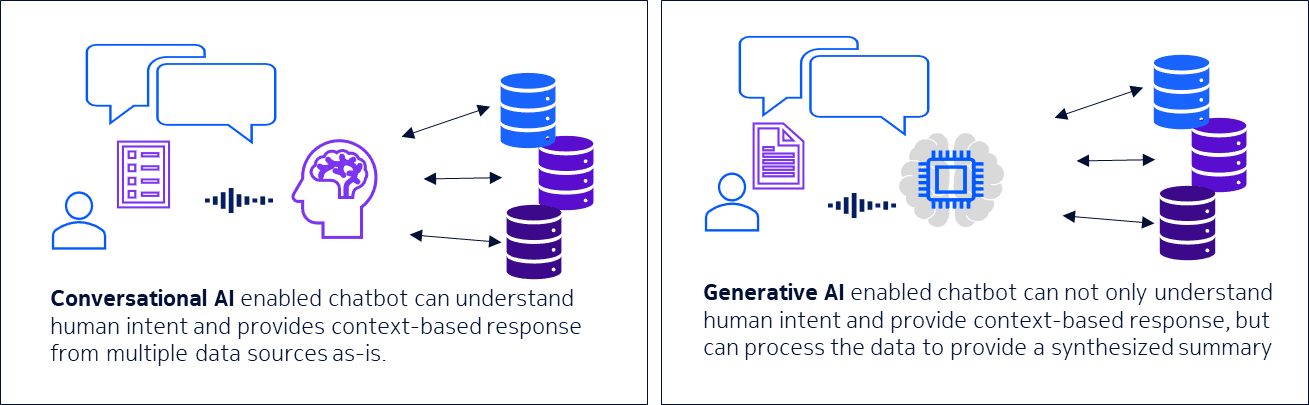
This is the category most marketers think of—and actually use.
Generative systems are built for ongoing work. They produce drafts, summaries, variations, outlines, and ideas, and they improve through follow-up. You can adjust direction, add context, or refine output without starting over.
That continuity is the key difference. The conversation carries the work forward instead of resetting it.
This is where conversational AI fits naturally into content creation (blog drafts, social variations, email copy, SEO elements, and campaign exploration), supporting real back-and-forth work.
Voice-First Assistants
Voice assistants aren’t part of day-to-day marketing production. But they influence how audiences phrase intent and what “natural language” sounds like outside a screen—through voice search, smart devices, and accessibility tools—which can inform messaging, SEO, and customer experience decisions upstream.
Omnichannel Conversational Systems
Omnichannel systems focus on continuity across platforms. Conversations don’t reset when someone moves from chat to email to social. Context carries through.
For larger teams and agencies, this matters when conversational AI supports both marketing and customer-facing work. The system recognizes who someone is, what’s already happened, and what shouldn’t need to be repeated.
Which Types Matter Most For Marketing Work?
- Blogs: Generative conversational AI
- Social media: Generative conversational AI
- Customer support: Rule-based or NLP assistants
- Market research: Generative models for summarizing and synthesis
- Analytics summaries: NLP or generative models, depending on the question
How Does Conversational AI Work?
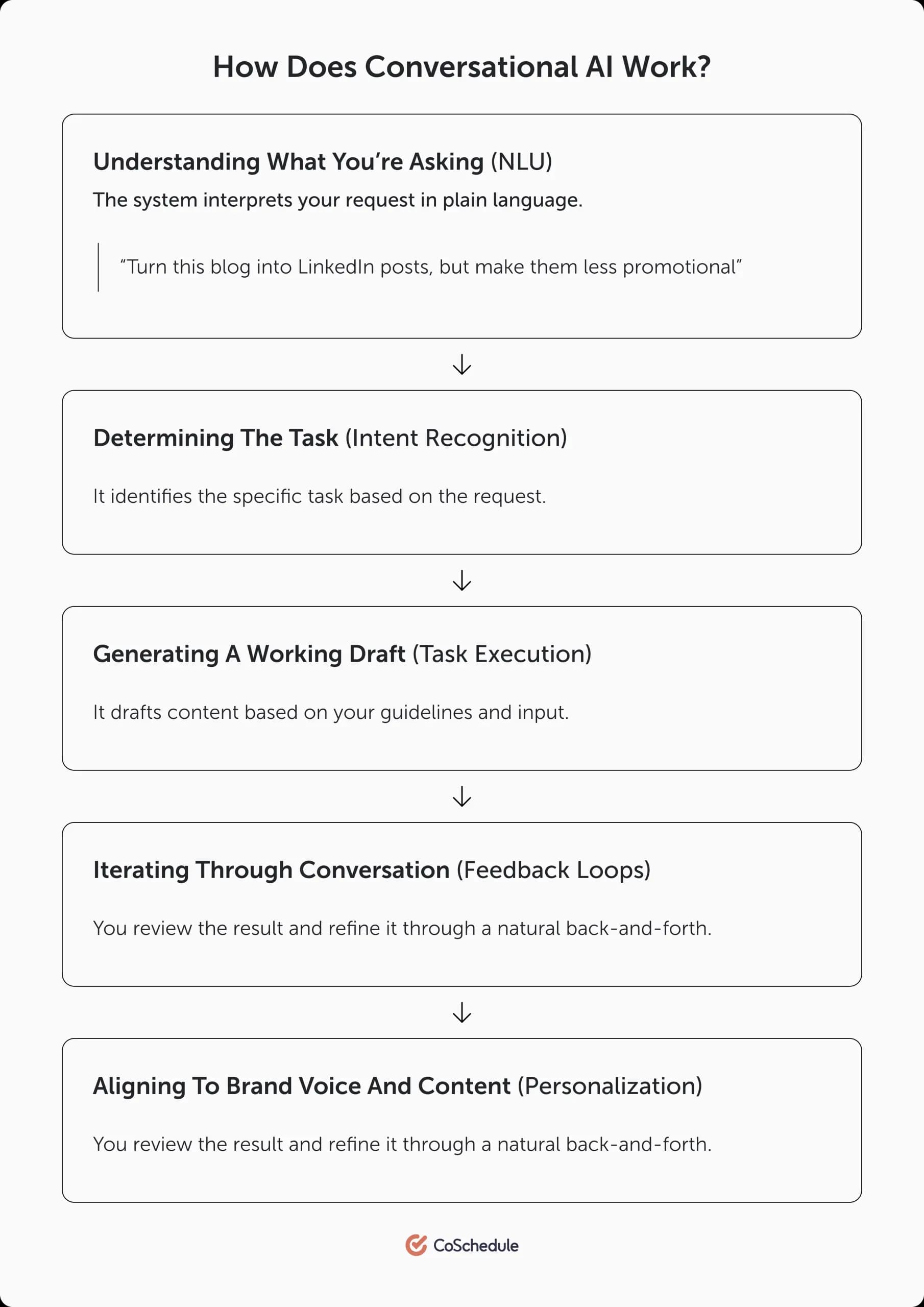
At a high level, conversational AI takes a loosely phrased request from you and turns it into action, then stays responsive as that work evolves.
Behind the scenes, a few core capabilities work together, in sequence, to make that happen.
Understanding What You’re Asking (NLU)
The system starts by interpreting your request in plain language. This is natural language understanding, or NLU.
If you say, “Turn this blog into LinkedIn posts, but make them less promotional,” the system can pick out:
- the source content (the blog)
- the output format (LinkedIn posts)
- the constraint you care about (tone)
You explain what you want in your own words. The system fills in the structure.
Determining The Task (Intent Recognition)
Next, the system figures out which task you’re asking it to do.
Is this a rewrite? A transformation? New material based on existing content?
That distinction matters because it directly affects the result. “Rewrite this paragraph” leads to a very different outcome than “Give me a few alternative ways to open this article,” even though both point to the same source.
Generating A Working Draft (Task Execution)
This is where understanding turns into output.
With intent clear, the system generates content or executes the task. In marketing work, that usually means drafting copy, creating variations, summarizing information, or organizing ideas.
The output is a working draft. Something you can shape, refine, and push further.
Iterating Through Conversation (Feedback Loops)
You can respond naturally. Like so:
- “Shorten it.”
- “That’s too formal.”
- “Rewrite this for a SaaS audience.”
- “Keep the structure, change the examples.”
Each response updates the same piece of work within the conversation. Context carries forward, so you’re refining what’s already there.
Aligning To Brand Voice And Context (Personalization)
When you share brand guidelines, examples, or internal terminology, the system adjusts its output to match.
That might mean aligning with your existing tone, following style rules, or using language your team already prefers. The more relevant context you provide, the more specific the output becomes.
Real Marketing Use Cases For Conversational AI
Blog Writing And Editing
Use conversational AI before line editing starts, as structure mistakes are expensive to fix later.
Test the shape of the piece first by exploring how the same idea works across different awareness levels or angles. Choose the version that aligns with search intent and business goals, then move forward.
Once the structure holds, draft selectively. Rewrite weak sections and leave strong sections alone. Save editing and SEO work for later.
Example prompts
- “Here are my notes. Show me several outline options with different positioning.”
- “Draft this section in about 250 words and keep the examples specific.”
- “Reduce this section by 20 percent and flag unclear passages.”
Social Media Repurposing
Start by extracting key angles from the asset. Each angle should stand on its own as a clear point of view or takeaway, not a sentence lifted from the original piece. Write social messages to work in-feed, without relying on the blog for context.
Plan for sequence as well. An introductory post should be followed by one that clarifies the idea, challenges it, or addresses likely pushback. That’s how individual posts add up to the momentum.
Example prompts
- “Pull eight angles from this article. Each should stand alone.”
- “Write two LinkedIn posts for angle four. One direct. One narrative.”
- “Draft a follow-up reply that addresses the most likely objection.”
Email Marketing Prompts
Email performance usually breaks at the framing level. The message is fine, but the value doesn’t show up quickly or clearly enough for the reader.
Diagnose this by isolating variables with conversational AI. Work on subject lines separately from body copy. Rewrite openings until the outcome is clear in the first few lines. Keep adjusting the CTA until the next step feels obvious.
Example prompts
- “Write subject lines that signal the outcome, not the feature.”
- “Rewrite the opening so the value is clear in the first two sentences.”
- “Revise the CTA to sound specific and natural.”
Campaign Ideation
Use AI to generate campaign options. Start with one insight and explore how it could be framed across different buyer stages, messages, and channels. Evaluate each angle against audience maturity, channel constraints, and internal capacity to decide what’s worth shipping.
Example prompts
- “Generate campaign angles built around this insight for different buyer stages.”
- “Which of these concepts works best for a mid-funnel audience, and why?”
- “Expand this idea into a campaign outline with key messages.”
Competitive Analysis Summaries
Work directly with competitor copy. When you review language side by side, patterns surface quickly, like shared phrasing or the same proof points. That contrast makes it easier to see where positioning collapses into sameness and where you still have room to say something meaningfully different.
Example prompts
- “Summarize how each competitor positions themselves using their own wording.”
- “Where does the language across these pages start to converge?”
- “Identify positioning angles that competitors reference but do not support well.”
Customer Feedback Analysis
Use AI to synthesize customer feedback so repeated language and points of resistance become visible. Feed those insights into landing pages, objection handling, and FAQs, and use them to pressure-test claims that sound strong in copy but don’t hold up in real use.
Example prompts
- “Group these comments into themes and include example quotes.”
- “Turn the strongest themes into landing page bullets.”
- “List claims we should avoid based on this feedback.”
SEO Optimization
SEO optimization breaks when a page reads well but doesn’t reflect how a searcher approaches the topic. You can turn to conversational AI to review content for gaps and misalignment without rewriting the draft. You’ll know whether the primary question is answered upfront and whether the page supports the follow-ups a reader expects.
Example prompts
- “Write a two sentence definition of this topic for marketers.”
- “Generate FAQs based on the content of this article.”
- “Revise this section to better match informational search intent.”
Read More: Free AI Writing Tools by Hire Mia
How Agencies Are Using Conversational AI to Scale Content Production
Agencies that get real value from conversational AI treat it as a production control layer, placing it where work typically stalls: early structuring, mid-process iteration, late-stage consistency checks.
Here’s what that looks like.
1. Starting From Structure, Not a Blank Page
Most agencies no longer open client work with an empty document. Conversational AI produces an initial structured pass that gives the work shape before senior talent gets involved.
What changes:
- Strategy → prompt → draft (instead of strategy → manual draft)
- Senior talent edits directionally instead of writing from scratch
You see this most clearly in how agencies prepare work for review:
- Blog outlines generated from client briefs
- Campaign angles drafted before creative review
- Content briefs created from internal notes or transcripts
2. Producing Variation Without Drifting off Message
Agencies struggle less with output volume than with message drift. Rewriting the same idea by hand across channels introduces inconsistency fast.
Conversational AI helps when teams define the angles first, then generate executions within those boundaries. One source asset can produce multiple expressions that stay aligned because they are derived from the same underlying intent.
In practice, agencies use it to:
- Pull discrete angles from a single piece of content
- Generate multiple executions for each angle
- Adjust tone, length, or format while keeping the core claim intact
Larger agencies formalize this inside production studios. Smaller teams achieve the same outcome through careful prompts and consistent review standards.
3. Shortening Revision Cycles Without Lowering Standards
Revision is where agency time disappears.
Conversational AI shortens this by:
- Making changes locally (“rewrite this paragraph”) instead of globally
- Allowing rapid alternatives without re-briefing
- Keeping context across iterations
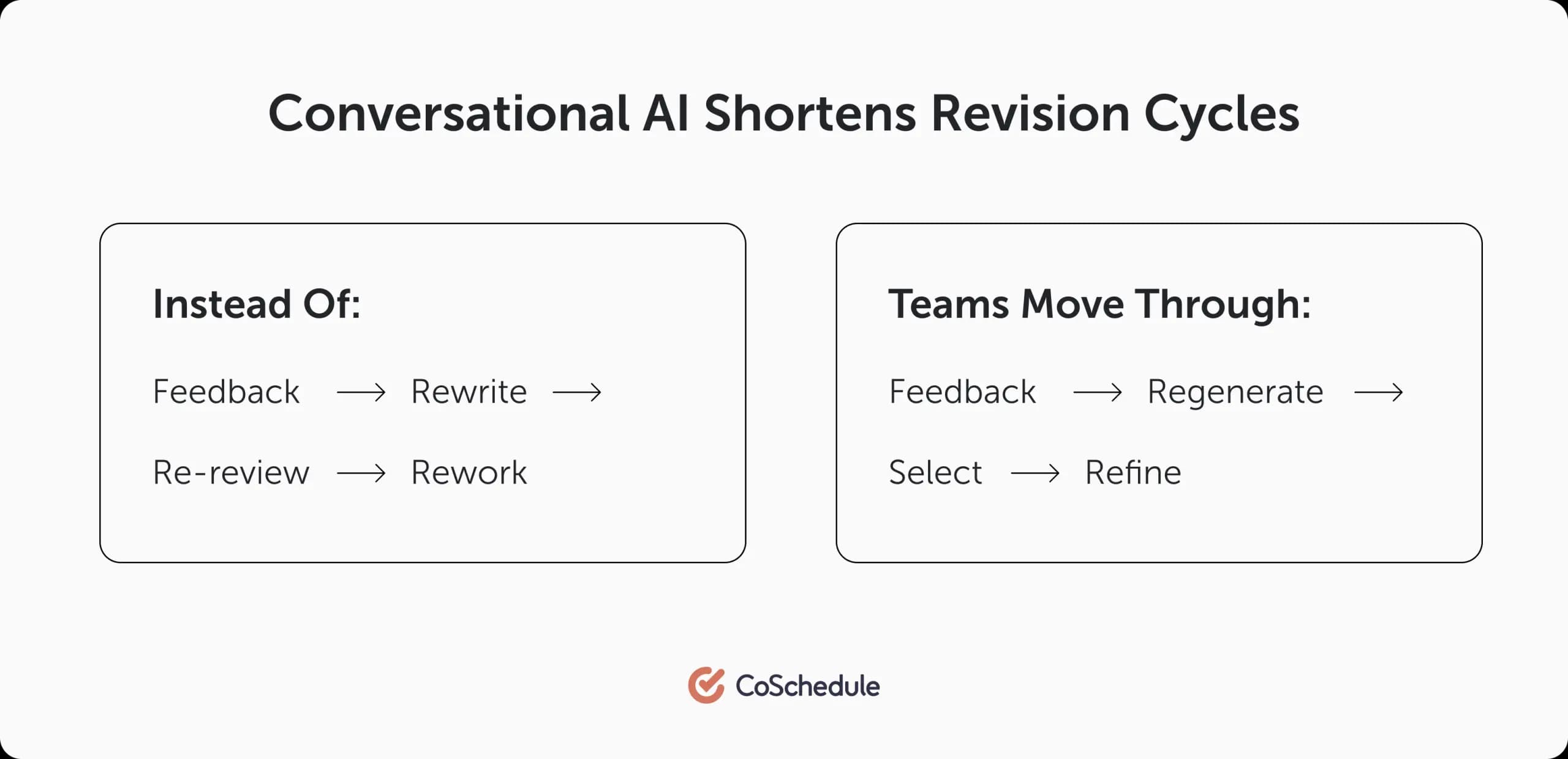
This is one of the biggest throughput gains agencies report internally, even if they don’t market it externally.
4. Standardizing QA and Brand Consistency
Agencies that scale successfully use conversational AI within clear guardrails. Brand voice references, approved language, and basic checks for tone and structure are built into the process, not added at the end.
This approach is already in use at the enterprise level. Wunderman Thompson partnered with STX Next to build Brand Guardian, an AI-based system that reviews creative assets against brand, legal, and accessibility guidelines before human review. According to VML, the system reduced manual review time by 74–92% and cut review costs by 50–83% by catching issues earlier in the process.
Smaller agencies do not need enterprise platforms to apply the same idea. Lightweight QA checks for brand language, consistency, and basic compliance can prevent higher content volume from turning chaotic.
Tips For Using Conversational AI Without Losing Your Brand Voice
- Anchor the system with real examples: Paste short excerpts from approved blogs, emails, or social posts. Concrete examples give the AI something specific to match.
- Keep prompts focused on one task at a time: Asking for a full article, multiple channels, and tone adjustments in one prompt often produces shallow results. Narrow prompts lead to clearer, more controlled output.
- Run a sameness check before publishing: A useful final step: “Highlight anything that sounds generic or could apply to any brand.” This helps surface filler language before it ships.
- Review for accuracy and context every time: Conversational AI can phrase ideas well, but it doesn’t know what’s sensitive, outdated, or strategically off-limits. Human review is still essential, especially for client-facing work.
Where Conversational AI Fits In CoSchedule’s Workflow
Conversational AI becomes useful once it stops feeling like a separate activity. When teams have to leave their planning tools to generate content, the output often stays disconnected from the work that follows.
That’s why Mia, CoSchedule’s Marketing AI assistant, shows up inside CoSchedule’s Calendar. Planning, drafting, and scheduling already happen there, so AI support appears at the same moment decisions are being made.
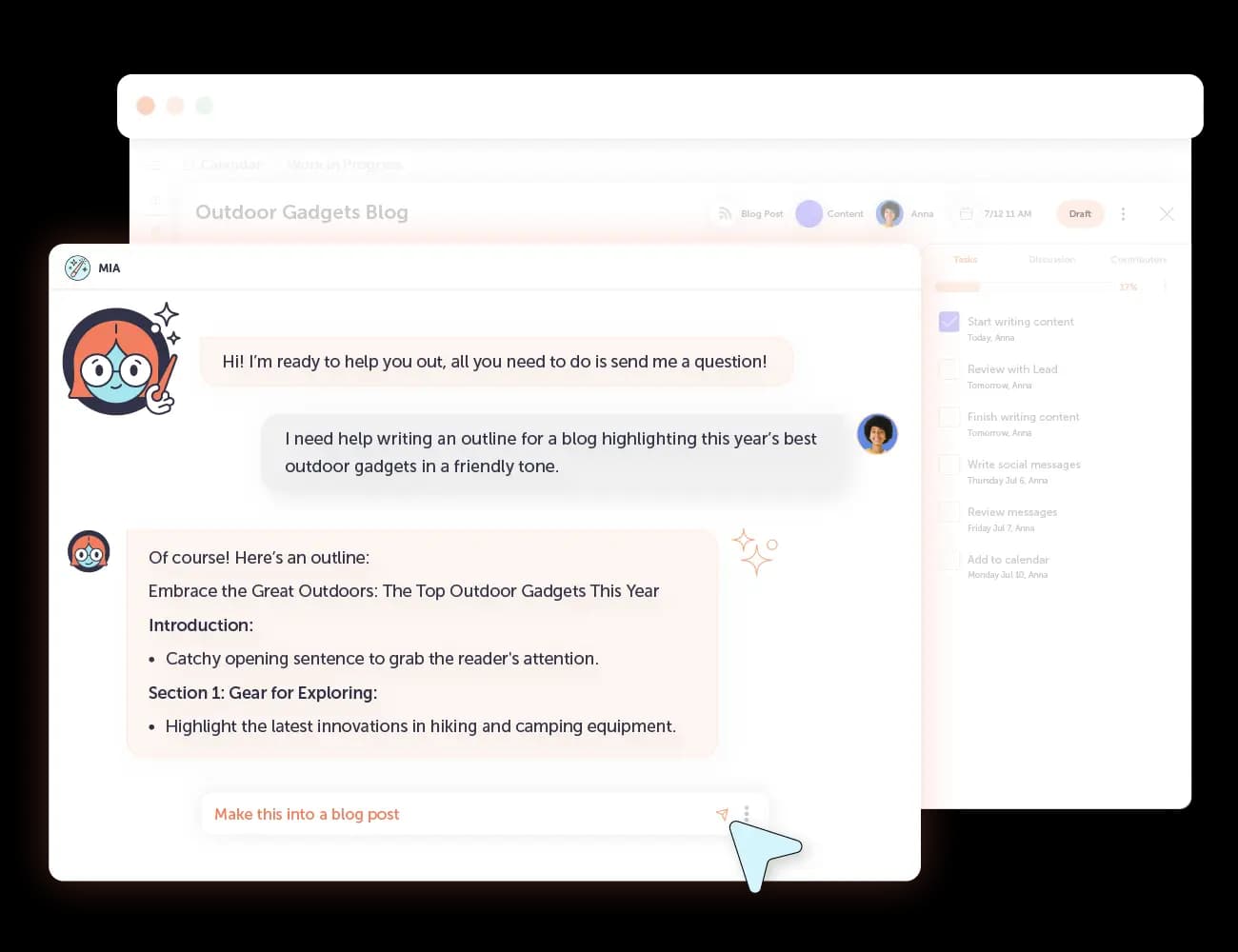
When teams work this way, they tend to use AI earlier and more deliberately. They:
- Generate blog outlines while planning a campaign, so structure and scope take shape before writing begins. Early drafts stay attached to the calendar, which makes ownership and timing clear from the start.
- Write social messages inside campaign plans, which keep distribution tied to the original intent of the content.
- Explore campaign angles conversationally, then convert the promising ones directly into projects. Ideas move forward while context is still fresh.
- Draft and refine headlines as part of the publishing process. Headline work happens alongside content development instead of being treated as a final check.
- Apply brand voice during drafting through Hire Mia’s Brand Profiles, which reduces cleanup and review cycles later.
This placement changes how work moves. Planning transitions naturally into drafts, and drafts progress into campaigns without extra coordination. Content gets reused without reopening decisions that were already settled.
If you’re already experimenting with conversational AI, the next step is bringing it closer to where content turns into published work.
Try CoSchedule’s AI Marketing Assistant to work with conversational AI built right into your marketing workflow.
